When you buy through links on our articles, Future and its syndication partners may earn a commission.

For the first time in more than 50 years, humans are cruising through lunar space.
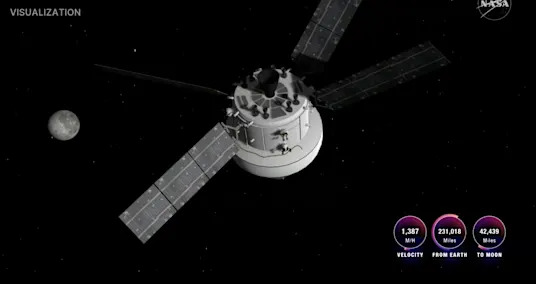
The four astronauts of NASA's Artemis 2 mission arrived in the moon's sphere of influence — the region where lunar gravity exerts a more powerful pull than that of Earth — today (April 6) at 12:37 a.m. EDT (0437 GMT).
The milestone occurred when the mission's Orion capsule was about 39,000 miles (62,764 kilometers) from the moon and roughly 232,000 miles (373,368 km) from Earth, a commentator said during NASA's Artemis 2 livestream.
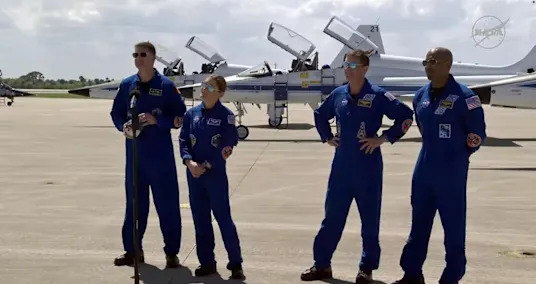
The Artemis 2 astronauts — NASA's Reid Wiseman, Victor Glover and Christina Koch and the Canadian Space Agency's Jeremy Hansen — are the first people to cross the lunar threshold since December 1972, when the three-person Apollo 17 moon-landing mission did so.
Artemis 2 will not touch down on the moon, or even enter lunar orbit. Rather, Orion will loop around the moon's far side this evening in a history-making flyby. During that encounter, Artemis 2 will get farther from Earth than any crewed flight ever has.
The distance record is currently held by the Apollo 13 astronauts, who got 248,655 miles (400,171 km) from our planet in April 1970. At the height of tonight's flyby, just after 7 p.m. EDT (2300 GMT), Artemis 2 will be 252,757 miles (406,773 km) away from the rest of humanity, NASA officials have said.
The Artemis 2 astronauts will study the moon during the flyby, gathering data that could help scientists better understand the terrain and geology of Earth's nearest neighbor. They'll also be treated to a total solar eclipse, which will not be visible to those of us here on terra firma.
In addition, the flyby will chart their path home: Lunar gravity will slingshot Orion back toward Earth. Artemis 2 astronauts will come home on Friday (April 10), ending their 10-day mission with a parachute-aided splashdown off the coast of San Diego.
Editor's note: This story was updated at 1:15 a.m. EDT on April 6 with NASA's revised time of Orion's entry into the moon's sphere of influence — 12:37 a.m. EDT rather than 12:41 a.m. EDT.
latest_posts
- 1
 I spent the last year transforming my life. Becoming a Rockette for a day made me confront a fear I couldn't shake.
 - 2Investigate These Retreats Well known With Seniors
- 3BHP liable for 2015 Brazil mine disaster: UK court
- 4Energy security rifts widen in Europe
- 5UB professor shares his experience on almost becoming an astronaut



- Geminid shooting stars: One of 2025's most exciting meteor showers begins tonight
- Want to make America healthy again? Stop fueling climate change
- 4 Family SUVs: Joining Solace and Style
- Egypt's cafés and shops forced to close early due to Iran war
- Europe: 4 Urban communities for a Paramount Social Experience
- Artemis II astronauts arrive in Florida to prepare for launch to the moon
- 'Zootopia 2' movie reviews: A heartwarming, hysterical and earnest 'ode to community'
- The Meaning of Breaking the Pen's Nib in Death penalties
- Dwayne ‘the Rock’ Johnson opens up about being the 'new guy' again — and why this moment feels like a new life